
AI “Therapy” at Sea: When Chatbots Help (and When They Can Make Things Worse)
You’re on board, it’s late, and you can’t sleep. You don’t want to worry your family. You don’t want to “make a big deal” onboard. So you open an AI chatbot and type: “I feel stressed. What’s wrong with me?”
This is becoming a real trend—and psychologists in the maritime space are already warning about the risks of using AI as mental health support, especially when someone is vulnerable.
AI can be useful in small, practical ways. But it can also be unsafe if you use it like a therapist, or if you share private details without thinking. The goal of this article is simple: help you use AI safely, and protect your mental health onboard.
Why AI feels so helpful when you’re at sea
AI is:
Available 24/7
Non-judgmental
Fast
Private (it feels private)
And when you’re tired, isolated, or under pressure, the brain naturally looks for quick relief.
But here’s the psychological catch:
In hard moments, we don’t need “nice words.” We need safe help.
Some chatbots are designed to agree, comfort, and keep you talking. That can feel good short-term, but it may miss risk, reinforce unhealthy thinking, or make you depend on it emotionally.
The big risks (in simple terms)
1) Privacy risk: you may share too much
If you type personal information (names, vessel details, medical info, photos), you may lose control of where it goes. Many tools are not health-care services and don’t follow medical privacy standards.
2) Wrong advice risk: confident doesn’t mean correct
AI can sound sure even when it’s wrong. That’s dangerous with sleep, panic, depression, medication, alcohol use, or trauma.
The APA (American Psychological Association) has warned that many AI chatbots and “wellness” apps don’t have enough evidence or regulation to keep users safe.
3) Crisis risk: AI is not for emergencies
If someone is in crisis (self-harm thoughts, feeling unsafe, severe panic, psychosis), AI is not the right support.
Maritime industry guidance specifically points seafarers to trained help like SeafarerHelp for urgent emotional support.
So… should seafarers use AI at all?
Yes—as a tool, not as a therapist.
Think of AI like a basic gym app:
It can guide a routine.
It can’t diagnose your injury.
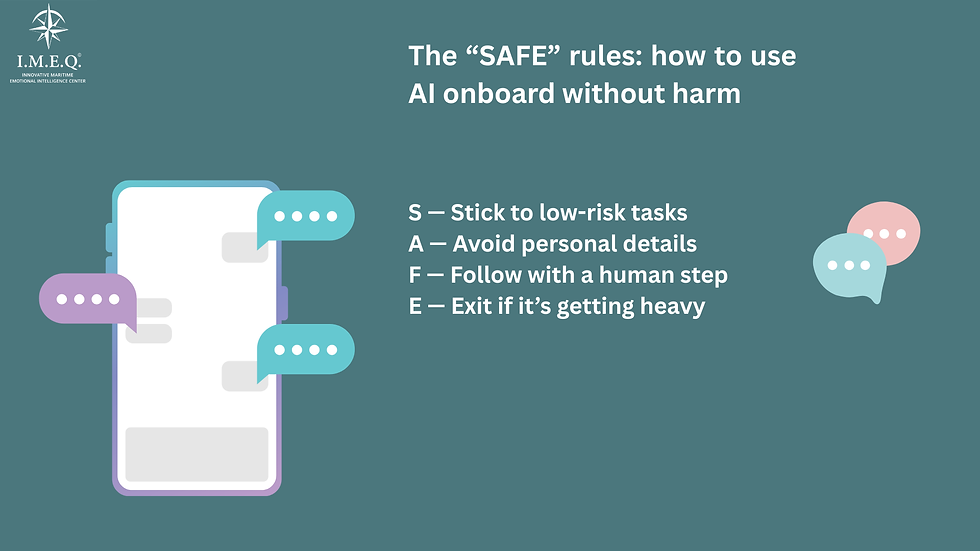
The “SAFE” rules: how to use AI onboard without harm
S — Stick to low-risk tasks
Use AI for:
journaling prompts (“Help me write what I’m feeling in 5 lines.”)
simple breathing steps
planning a healthy routine (sleep / exercise / food)
communication help (how to say something calmly to a crewmate)
learning basics (what is anxiety, what is burnout—general info)
Avoid using AI for:
diagnosis (“Do I have depression?”)
medication advice
trauma processing (“Tell me what my childhood means…”)
relationship “decisions” in high emotion (“Should I divorce?”)
anything that replaces real support
(If you use it, keep it practical and short.)
A — Avoid personal details
Do not type:
your full name, crew names, vessel name, company details
medical records
private photos
passwords, codes, or documents
If you need help, write like this instead:
“A person working long shifts at sea is feeling stressed and can’t sleep. What are 3 safe steps they can try tonight?”
F — Follow with a human step
After AI gives you suggestions, do one human action:
talk to a trusted crewmate
tell your officer you’re not sleeping well
contact your company support (if available)
contact a seafarer helpline if you need emotional support
ISWAN’s SeafarerHelp exists for this: free, confidential, multilingual, 24/7.
E — Exit if it’s getting heavy
Stop using AI and get real help if you notice:
you’re using it for hours
you feel worse after chatting
you start believing “only the bot understands me”
you’re hiding how bad things are
you have thoughts of self-harm or feel unsafe
Recent real-world cases and investigations have increased scrutiny about chatbot safety in vulnerable situations. Don’t gamble with your wellbeing.

A 7-minute “Mental Reset” you can do after your shift (with or without AI)
Minute 1: Name itSay (to yourself): “I’m stressed / lonely / angry / tired.”Naming feelings reduces pressure.
Minute 2–3: Breathe (simple)Inhale 4 seconds → hold 2 → exhale 6. Repeat 5 times.
Minute 4: Body checkDrink water. Stretch neck/shoulders.(When the body calms, the mind follows.)
Minute 5: One small controlPick ONE:
tidy your bunk area for 2 minutes
prepare tomorrow’s socks/uniform
write a 3-line plan for tomorrow
Minute 6–7: ConnectionSend one message to someone safe, even short:
“Just finished my shift. Tired today. Hope you’re okay.”
If you want to use AI here, use it only like this:
“Give me a short message I can send home that sounds warm but simple.”
Quick checklist: “Am I using AI in a healthy way?”
I’m using it for skills, not therapy.
I’m not sharing private details.
I stop if I feel worse or dependent.
If things feel serious, I contact a human support option (company channels / SeafarerHelp / professional support).


I was diagnosed with Parkinson’s disease four years ago. For over two years, I relied on Levodopa and several other medications, but unfortunately, the symptoms kept getting worse. The tremors became more noticeable, and my balance and mobility started to decline quickly. Last year, out of desperation and hope, I decided to try a herbal treatment program from NaturePath Herbal Clinic.Honestly, I was skeptical at first, but within a few months of starting the treatment, I began to notice real changes. My movements became smoother, the tremors subsided, and I felt steadier on my feet. Incredibly, I also regained much of my energy and confidence. It’s been a life-changing experience I feel more like myself again, better than I’ve felt…